The writing desk / Content strategy
What Makes Quality Content? A Practical Review Framework
Review articles, landing pages, emails and documentation for clarity, evidence and usefulness. Build a better copywriting brief with this framework.
Quality content helps a particular reader understand something important, make a better decision or complete a task. It is accurate enough for its purpose, specific enough to be useful and organised so that the reader can find the answer. Attractive formatting and polished sentences support that work; they do not replace it.
For a business, quality also includes a clear relationship between the page and the offer. An article can answer a genuine question and naturally introduce a relevant service. A product guide can reduce uncertainty before a purchase. A welcome email can explain what happens next. Each format needs a different kind of review.
This is TechEnvolved's practical editorial framework, not an official Google score or a ranking formula. The examples are hypothetical. For the broader search context, read our guide to Google's helpful content recommendations and the official Google documentation.
Start by defining what the reader needs to do
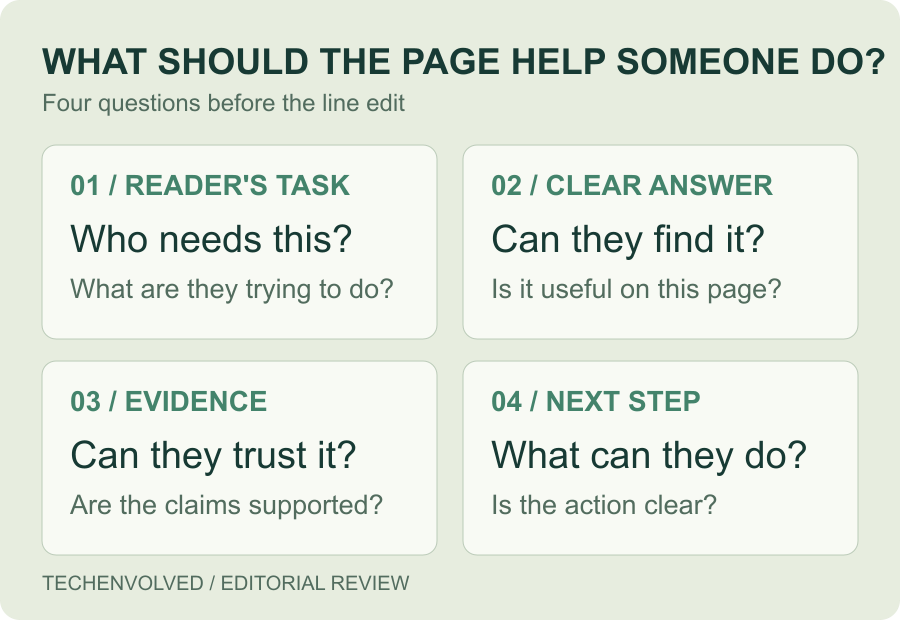
The word quality is too broad to be a useful brief on its own. Ask what a person should be able to do after reading. A restaurant owner might need to compare website proposals. A software user might need to recover from an error. A new subscriber might need to understand what the first email promises.
Write the expected outcome in one sentence. Then name the conditions: the reader's starting knowledge, available information, budget constraints or technical access. These details stop the writer from producing an answer for an imaginary expert with unlimited time.
Consider a hypothetical onboarding article. A vague goal says explain the dashboard. A useful goal says help a first-time account owner invite a colleague without giving them billing access. The second goal makes the missing information obvious: permissions, prerequisites, steps, expected result and recovery options. The writing can now be judged against a real task.
Separate evidence from confident language
Specific claims need appropriate support. Numbers should have an origin. Product instructions should match the version being discussed. Customer stories should use approved material. The fact that a sentence sounds confident does not make it reliable.
Build a simple claim register during editing. For each important assertion, note the source, the date checked and any limitation. A product specification is different from a customer interview, and both are different from the writer's opinion. Preserve those distinctions in the published wording.
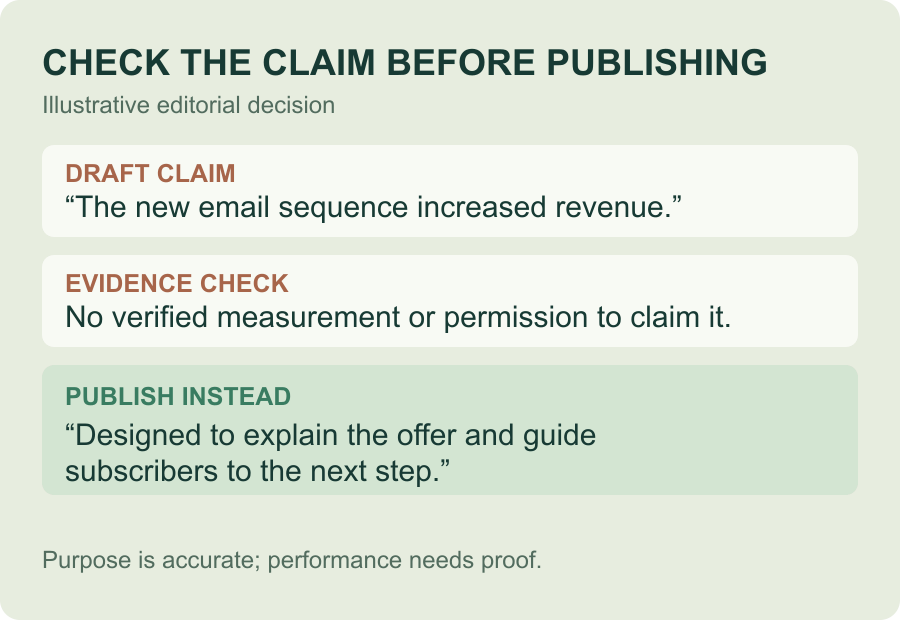
For example, saying a new email sequence increased revenue requires credible measurement and permission to share it. Without that evidence, describe what the sequence is designed to do: explain the offer, handle a specific objection or guide a subscriber towards an appropriate next step. Purpose can be described honestly without inventing performance data.
Look for useful specificity, not decorative detail
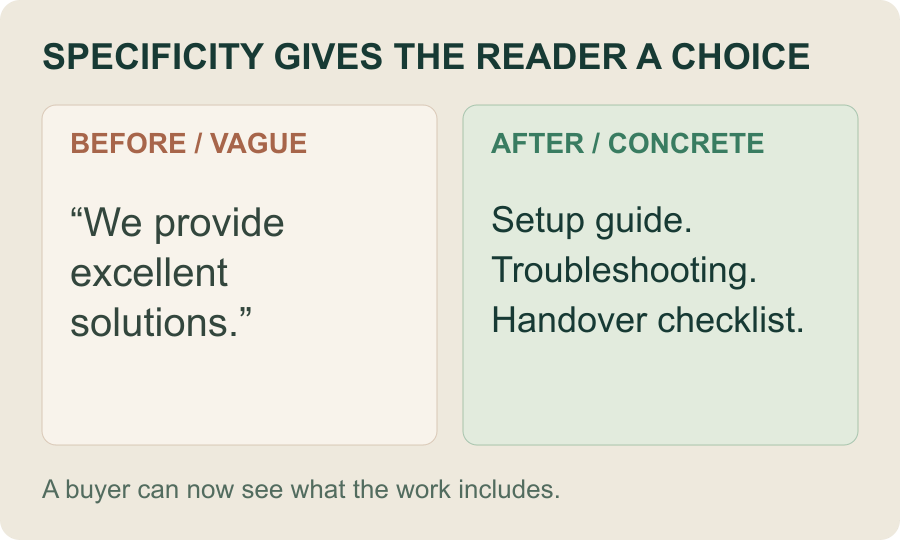
A sentence such as we provide excellent solutions tells the reader almost nothing. A sentence explaining that a documentation project includes a setup guide, troubleshooting page and handover checklist gives the buyer something to evaluate. Specificity makes an offer concrete.
The same principle applies to educational content. Instead of advising a business to improve its service pages, show the questions a visitor needs answered: what is included, who does the work, what inputs are required, how revisions are handled and what happens after the enquiry. Our local SEO audit checklist shows this approach in a specific, step-by-step guide.
Avoid details that create a false impression of experience. An invented quotation or imaginary client result does not become acceptable because it illustrates a sensible point. Label hypothetical examples and distinguish them from published work. Useful specificity comes from clear thinking and real material, not from making a generic paragraph appear more personal.
Match the review to the format
For an SEO article, examine whether the main question is answered early, the explanation adds value and the sources support its claims. Check that a reader can follow the structure without already knowing the subject. Our SEO keyword research tools guide can help investigate how people phrase the question; the editorial review still needs to judge whether the page answers it. Relevant internal links should explain where to go next.
For a landing page, review the offer, audience, evidence, objections and action. A beautiful introduction is not enough if the buyer cannot tell what they will receive. The page should make it easy for a suitable prospect to decide whether the service fits.
For an email sequence, read the messages together. Does each email have a distinct purpose? Are the timing and next action sensible? Do subject lines match the content? A sequence should progress instead of repeating the same pitch with different openings.
For social media, assess whether the post works in its actual channel and whether the hook is supported by the body. For documentation, try the procedure. If the expected result is absent or an instruction depends on an unstated permission, the content needs revision even when the grammar is perfect.
Make editing a sequence of decisions
Begin with the largest questions. Is this the right page for the task? Does it have the necessary evidence? Are sections missing or in the wrong order? Only after those questions are resolved should the edit focus on sentence rhythm and punctuation.
A useful structural edit removes repetition and brings qualifications closer to the advice they affect. If a recommendation only applies to small sites, the reader should discover that before following it. If two sections reach the same conclusion, combine them or give each a different job.
During a line edit, replace vague nouns and inflated promises with concrete actions. Reduce unnecessary introductions. Explain terminology when the reader first needs it. Read the calls to action separately: they should be understandable without depending on a paragraph the visitor may have skipped.
This sequence prevents an expensive mistake: polishing a draft that needs a different structure or better research. Good editing improves the reasoning as well as the prose.
Use tools as diagnostics
Readability calculations can reveal unusually long sentences or dense vocabulary. They cannot decide whether a claim is accurate, an example is relevant or a technical term is necessary. The readability checker is a starting point for an editor, not a quality certificate.
The keyword density tool can reveal repetition. It does not establish an ideal percentage that guarantees visibility. If replacing a repeated phrase makes the explanation clearer, revise it for that reason rather than chasing a score.
A SERP preview helps examine the relationship between a proposed title and description. A social preview tool helps prepare sharing metadata. Neither can promise the exact presentation a search engine or social platform will choose.
Use each tool to ask a better question. Then make an editorial decision based on the task, the audience and the evidence. A dashboard full of green indicators is not the same thing as a page a reader can trust.
Give AI-assisted drafts a real review
An AI-assisted draft still needs an owner. Check factual statements against sources, remove invented details and review the examples for hidden assumptions. Make sure the text reflects the actual offer rather than a plausible version of a business the tool has inferred.
Also inspect the supporting elements. A sensible body can be paired with an exaggerated meta description, an inaccurate image caption or structured data claiming information that is not on the page. The review should include those elements, not stop at the last paragraph.
Agree who is responsible for specialist review. A general copywriter can make technical material clearer, but a product expert still needs to confirm product behaviour. Sensitive or regulated claims require the appropriate reviewer. Review responsibilities should be visible in the brief rather than discovered after publication.
A compact quality review checklist
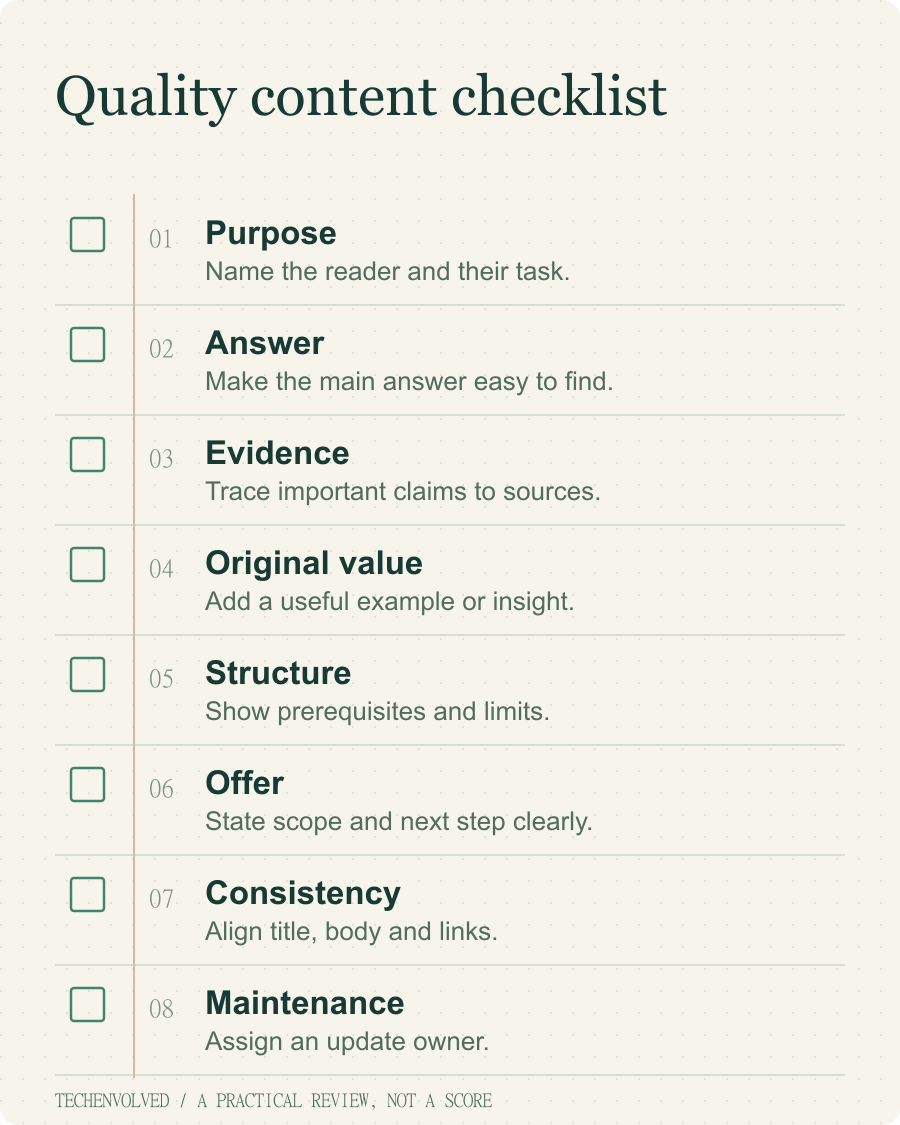
Use these questions as an editorial discussion, not a numerical ranking score:
- Purpose: Can you name the reader and the decision or task this page supports?
- Answer: Can a visitor quickly find the main answer without reading every paragraph?
- Evidence: Can important factual claims be traced to suitable, current sources?
- Original value: Does the page add an example, explanation, tool or perspective beyond a generic summary?
- Structure: Are prerequisites and limitations presented before they affect an action?
- Offer: If the page is commercial, are the deliverables and next step clear?
- Consistency: Do the title, description, body and links describe the same promise?
- Maintenance: Is someone responsible for keeping time-sensitive material accurate?
A failed item should produce a specific task. Missing evidence means gather evidence or qualify the claim. Unclear scope means rewrite the offer. Repetition means consolidate. This is more actionable than telling a writer to make the piece more engaging.
Turn the review into a better brief
Choose one page or sequence before commissioning a large volume of new material. Identify what needs to change, what source material is available and how the revised content will be reviewed. A focused brief makes it easier to estimate the work and assess the result.
For example, a service business might start with one landing page and a short follow-up email sequence. The same research can inform both, while each deliverable serves its own purpose. Once the message is clear, supporting articles and social posts can extend it without becoming copies of the landing page.
If you need help with that work, TechEnvolved's SEO copywriting and content writing service covers articles, website copy, landing pages, email sequences, SMM content, product documentation and editing. The first step is to define the audience, objective, evidence and format. Quality becomes easier to achieve when the brief makes those decisions explicit.